
Tag: ETH

  • Arrived in Göteborg

    Plane without my luggage

    ©Spaeth, Plane without my luggage

    Right after my holidays, I had a few hours to unpack and repack and make my way to Göteborg, as a visiting scholar at the IT University in Göteborg with Jan Ljungberg. I last visited them in 2003, so it has been a while.

    One thing I will never understand is luggage transport and customer service with airlines. I understand that things are made more complicated by the interaction of multiple organizations, but are airlines not supposed to be good at processes and customer service?

    This time, they did not even board my luggage in Zurich, my starting destination. So obviously, it also did not make its way to Copehnhagen, or Göteborg. So I am now left without any luggage… again. On average, 3.6 Passengers out of 1,000 reported lost luggage in Dec/Jan 2011 [USFlightStats], unfortunately, I seem to always be one out of them.
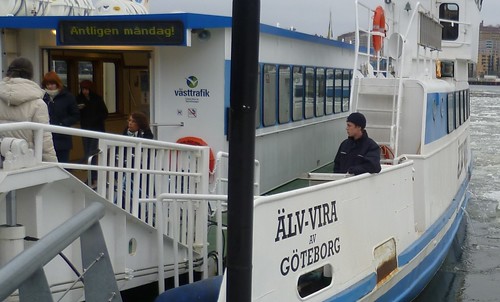
    Äntligen Måndag

    ©Spaeth "Äntligen Måndag!"

    Otherwise, I am still in the process of getting set up and going again. I will be enjoying this stay, but I hope it is also going to be a productive time.

  • Chair retreat (nearly) in Italy

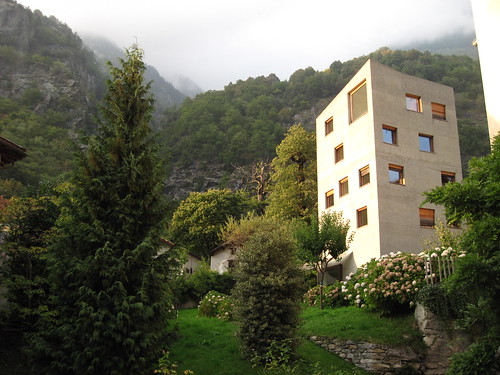
    The new building

    ©Spaeth, licensed: CC-BY-3.0

    Our chair went for the traditional retreat. This time, far far away in Castasegna. ETH owns a house there, Villa Garbald, which has been designed by Semper (the same as the Dresden Semper Opera). The villa is beautiful, and the surroundings of Castasegna are beautiful too. It is located 30 Meters from the Italian border and it is the coolest border I have ever seen. They put up a swing on the border line and you can swing back and for between the EU and Switzerland. Also put up a mirror where you can see yourself on the other side of the border. Fun.

    The new building

    ©Spaeth, licensed: CC-BY-3.0

    As for the retreat itself, it was a nice team experience, as usual. We have grown so much that we hardly know all the others anymore. Team retreats are a good way to laugh, to complain, to drink and to chat together, which is rare enough.

    A pity that Almut has to care for 2 sick kids at home on her own, I’ll have to make that up at some point in time… Thanks Almut.

  • THE-Ranking: ETH auf Platz 15

    ETH life berichtet:

    Das Times Higher Education World University Ranking (THE) 2010 wurde anhand neuer Kriterien und Methoden erstellt. Deshalb lässt es sich nur schwer mit dem vorjährigen Ranking vergleichen. Gemäss der neuen Bewertung ist die ETH Zürich von Platz 20 auf 15 vorgerückt.

  • Riley Crane wins the DARPA challenge

    A short while ago I saw an article on a DARPA challenge, in which the first team to submit the locations of ten red weather balloons win 40,000$. An interesting experiment, I thought.

    Today I learn that my ex-colleague Riley Crane, who worked in the same building as I until October last year, has actually won the challenge! Congratulations, I did not even know that he was taking part in that. He is at the MIT Media lab now.

    He was interviewed in this Colbert Show.

  • I’m moving

    I move into a new building. Or rather not :-). In the very unlikely case I would still be working at ETH/MTEC in the autumn of 2013 (optimistic planning), we’ll get a brand new department building. ETH Life has a German article on the planned new building close to the ETH main building. 10 floors above ground and 5 floors below, I do know where I would get an office….

  • Published article in R&D Management

    R&D Management published our article on the development of the Nokia Internet Tablet. A preprint draft can be downloaded from here.

    Please welcome:

    Stuermer, M.; Spaeth, S. & von Krogh, G., Extending private-collective innovation: a case study, <em>R & D Management</em>, 2009, 39(2), 170-191

    ABSTRACT

    The private-collective innovation model proposes incentives for individuals and firms to privately invest resources to create public goods innovations. Such innovations are characterized by non-rivalry and non-exclusivity in consumption. Examples include open source software, user-generated media products, drug formulas, and sport equipment designs. There is still limited empirical research on private-collective innovation. We present a case study to (1) provide empirical evidence of a case of private-collective innovation, showing specific benefits, and (2) to extend the private-collective innovation model by analyzing the hidden costs for the company involved. We examine the development of the Nokia Internet Tablet, which builds on both proprietary and open source software development, and that involves both Nokia developers and volunteers who are not employed by the company. Seven benefits for Nokia are identified, as are five hidden costs: difficulty to differentiate, guarding business secrets, reducing community entry barriers, giving up control, and organizational inertia. We examine the actions taken by the management to mitigate these costs throughout the development period.

  • Int. Journal of Open Source Software & Processes

    A new journal is being founded that is dedicated to open source, the International Journal of Open Source Software & Processes (IJOSSP).

    Have a close look at the editor’s list and you’ll spot my name as one of the founding editors. This journal is going to rock.

    And no, this is not an April 1st joke.

  • Peter Jaeger has a blog

    It must have been the first thing he did when moving to Switzerland: Registering Spiegelschlag.ch and putting his photo blog there. Additional plus: Most of his pics are creative commons licensed. Yay for that. Now Zeynep is the only one at the chair without a blog :-).
    If you are interested in sailing pictures, or those of Stefan Haefliger’s marriage, this site is a must! Nice layout too…

  • Seminar on user innovation

    I am currently attending the seminar on user innovation at the Technical University Munich. The atmosphere is very much informal and relaxed, I enjoy that. Eric von Hippel is undoubtably the star of this community: having pursued the topic since the mid 70s (as far as I know), he also deserves this. Looking forward to the rest of the seminar… (now back to listening to the presentations :-))

    By the way, Stefan Haefligers presentation was gradually moved forward, so that he is now second after the opening speech (and Karim Lakhanis presentation).